


Particle Party!

In between watching gorgeous sunsets and enjoying the flying fish, we've managed to fit in a lot of science, and at least a couple hours of sleep! One of our main cruise objectives is to understand the sinking organic matter in this region, which includes "marine snow", to understand why this part of the ocean is so efficient at trapping carbon.
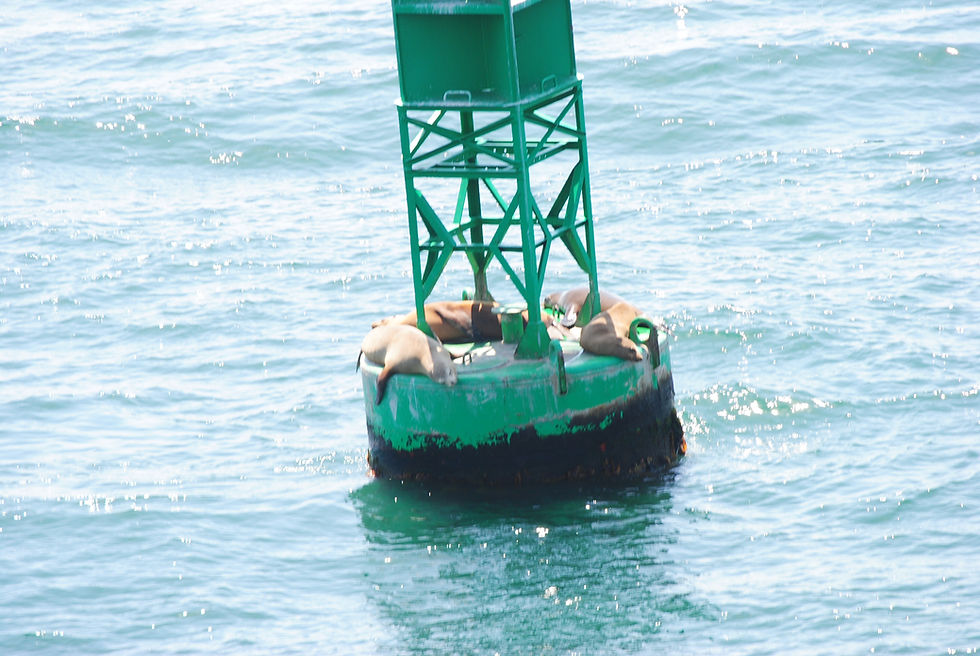
We use two types of tools to catch this sinking organic matter: net traps and Particle Interceptor Traps (PITs). Our net traps act like big funnels, catching anything sinking through the water column in a bottle at the bottom of the net. We keep them attached to floating buoys with ropes measured to specific lengths and let them drift with the currents. When we get them back, we can measure exactly how much carbon we caught and analyze what exactly it is, letting us compare how much of this sinking material makes it down to the bottom of the ocean to become sediment.

Our group is particularly (particle-y?) interested in how sulfur might play a role in preserving the sinking carbon. In most parts of the ocean, carbon is quickly recycled in the surface ocean. Phytoplankton and algae take carbon out of the atmosphere with photosynthesis, but as they die and start sinking, they quickly get eaten and turned back into carbon dioxide through respiration. At our study site, though, there is a large section of the ocean with no oxygen. In these anoxic sites, microbes that live on these sinking particles can "breathe" sulfate instead of oxygen, which they turn into sulfide (you might recognize sulfide as a stench of rotten eggs, or the smell of the lagoon on the UCSB campus after a wet winter). Sulfide can react with organic molecules in a really interesting way, turning simple structures that are easy for microbes to eat (and turn back into carbon dioxide) into a complex structure that's hard to break down. This process is called organic matter sulfurization, and we think that might be happening here!


After collecting our samples, running our experiments, and analyzing our data, we hope to be able to tell you how sulfurization plays a role in this exceptional carbon preservation, and hopefully think about what that means for climate and carbon cycling.


Sometimes I look for interesting information, reviews, or expert commentary because someone drops a link in a group—they are genuinely engaging, but sometimes you read through an article and find such useful links neatly woven right inside the text. For example, I recently came across a great overview on platforms like https://www.politolog.net.ua/ and https://deribasovskaya.net/